Few Japanese art forms have enjoyed as much popularity in the United States as the Japanese-style garden. First introduced to this country at the 1876 Philadelphia Centennial Exposition, these gardens immediately captured the imagination of the American public. Displays of Japanese-style gardens and pavilions soon became a fixture at virtually all expositions and World’s Fairs, and they also proliferated in public parks, school grounds, business properties, and private estates of the wealthy. By 1920, many of today’s popular gardens had already been constructed. This included the Japanese Tea Garden in San Francisco’s Golden Gate Park (1894), the Japanese Hill-and-Pond Garden at New York’s Brooklyn Botanic Garden (1914-1915), the Japanese Friendship Garden at San Diego’s Balboa Park (1915), and the Japanese Tea Garden in San Antonio’s Brackenridge Park (1919).
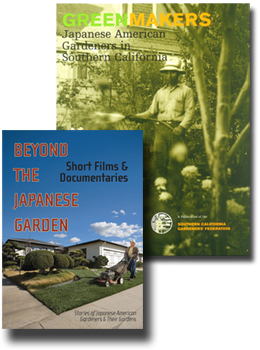
In the midst of the public’s growing fascination with Japanese-style gardens during this period, gardening became an accessible vocational opportunity for many Japanese Americans. Anti-Asian prejudice was prevalent, which resulted in social conditions and discriminatory legislation preventing Japanese Americans from finding employment in most professional fields. But interestingly enough, this period also gave rise to the popularity of Japanese-style gardens, as well as the stereotype that all people of Japanese descent were adept at gardening and cultivating plants. Faced with growing demand for Japanese American gardeners in light of limited professional job options, many Japanese Americans turned to gardening and landscaping as a viable way to making a living. This decision was bolstered by the fact that launching a gardening business was relatively simple, with low start-up costs and low requirements for English proficiency.
Those who entered gardening and landscaping came from a wide range of backgrounds and adopted various roles in the field. Some had extensive backgrounds in the arts. This was the case with Shogo Myaida, a Japanese immigrant with architectural and horticultural credentials who designed prominent gardens on the East Coast, and Sadayuki Uno, who applied his formal training in art and photography to landscape residential homes on the West Coast. Others switched to gardening after laws were passed in the 1910s and 1920s prohibiting Issei (first-generation Japanese Americans) from owning land, which made farming an increasingly difficult occupation. Shigezo and Chotaro Tashiro were brothers who made this transition from farm laborers in California to successful landscapers, gardeners, and owners of a nursery in Florida.
Regardless of their diverse backgrounds, Japanese American gardeners joined forces to develop vibrant communities and networks, which allowed them to socialize, gain political leverage, and pool their professional expertise for community projects. Over the past 100 years, they have established formal associations throughout the West Coast and donated their labor and materials to important community gardens, such as the James Irvine Garden in Little Tokyo, Los Angeles, which was designed by landscape architect Dr. Takeo Uesugi, and built by a coalition of gardeners, contractors, and nurserymen in 1979 to promote Japanese American arts and culture.
Today, many of the associations founded by Japanese American gardeners continue to survive and provide services for their members. However, the number of Japanese American gardeners has decreased dramatically over the last twenty years as professional opportunities opened up for younger generations, leaving little incentive for them to pursue full-time gardening work. Moreover, the gardening profession in Southern California is now increasingly Latino, as newer immigrants enter the profession for some of the same reasons that Japanese gardeners did nearly a century ago. Nonetheless, the influence and contributions of Japanese American gardeners survives to this day through the gardens they helped create, the public landscape projects they initiated, and the countless yards in residential homes that bear their aesthetic legacy.
* This article was originally published in the Japanese American National Museum online.
© 2007 Japanese American National Museum